


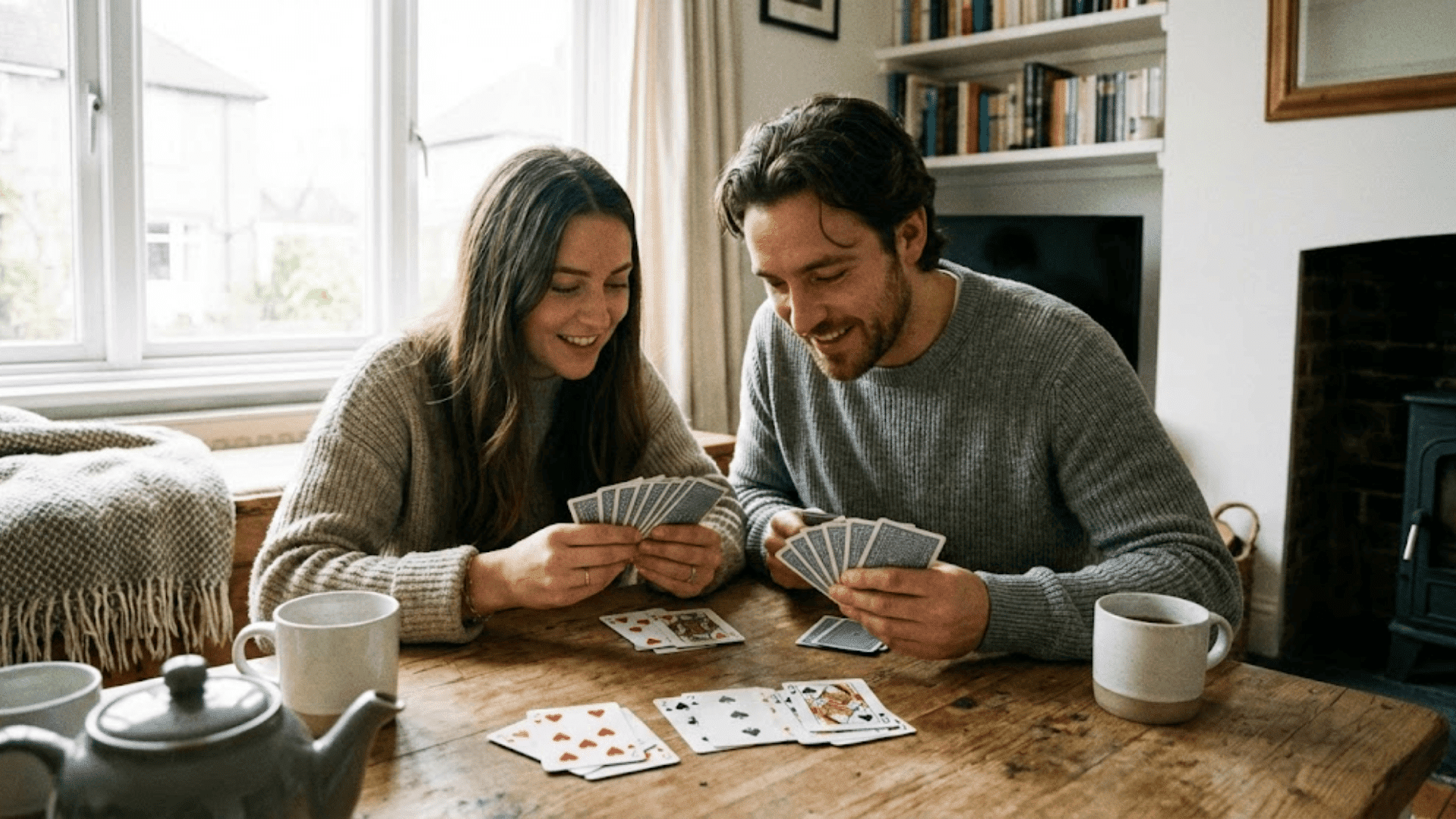
Looking for fun ways to spend quality time with a friend or partner? The best two-player card games deliver hours of entertainment with just a standard deck.
From quick luck-based battles to strategic showdowns that test your brain, these games work anywhere – at home, while traveling, or during camping trips.
You don’t need expensive equipment or complicated rules to enjoy intense competition and genuine laughter.
Grab a deck of cards and get ready to experience classics like Gin Rummy, fast-paced options like Speed, and clever choices like Cribbage that keep both players hooked from start to finish.
How to Choose the Right Two-Player Card Game?
Choosing the right two-player card game depends on the type of experience you want. Some games, like War and Go Fish, are simple and rely mostly on luck, making them great for quick and casual play.
Others, such as Gin Rummy, Cribbage, and Cuttle, require more strategy and planning. If you enjoy fast action, Speed and Spit keep both players busy from start to finish.
For a more relaxed game night, matching and trick-taking games offer a slower pace. Think about how much time you have, your skill level, and how competitive you want the game to be before picking a favorite.
Rummy and Melding Games
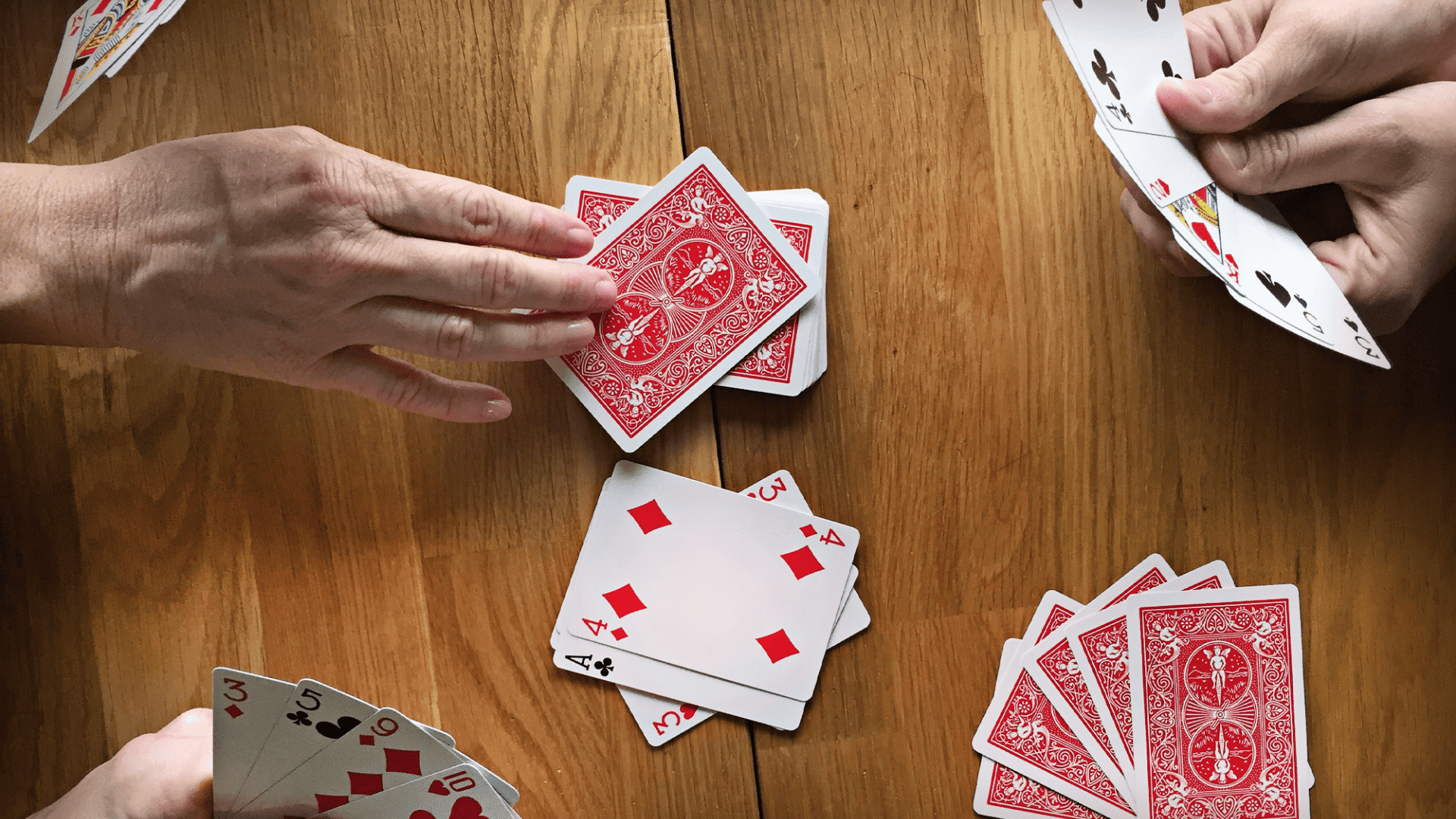
These games focus on making groups of matching cards or sequences in the same suit. They suit players who like to think ahead and make wise choices while using just one standard deck of cards.
Each game offers fun competition and chances to improve with practice.
1. Gin Rummy
Gin Rummy is a popular draw-and-discard game for two players. You try to form sets of three or four cards of the same rank or runs of three or more cards in the same suit.
The goal is to arrange your cards so your unmatched cards have low points, then knock or go gin to end the round and score points. It builds excitement as you watch what your opponent discards.
How to Play
- Deal 10 cards to each player from a standard 52-card deck.
- Place the rest face down as the stockpile and flip the top card face up to start the discard pile.
- On your turn, draw one card from the stock or discard pile, then discard one card from your hand.
- Form melds in your hand (sets or runs) and knock when your deadwood is 10 points or less, or declare gin with zero deadwood.
- After knocking, show hands, count points from the opponent’s deadwood, and play until one reaches 100 points.
Game Details
- Decks: 1 standard 52-card deck (no jokers)
- Time: 20-30 minutes per game
2. 500 Rummy
500 Rummy is a point-scoring version where you build melds and lay off cards on existing ones.
For two players, it uses more cards in hand, so you have plenty of chances to make big scores. You can pick up from the discard pile to grab useful cards. Many people enjoy it because games last longer and allow clever plays.
How to Play
- Deal 13 cards to each player from a standard 52-card deck.
- Place the remaining cards face down as the stock and flip the top one to start the discard pile.
- On your turn, draw from the stock or discard pile, then meld sets or runs if possible, and discard one card.
- Lay off cards on your own or your opponent’s melds to reduce your hand.
- The first to empty their hand ends the round; score points from melds and opponent’s remaining cards until one reaches 500.
Game Details
- Decks: 1 standard 52-card deck (jokers optional in some versions)
- Time: 30-45 minutes per game
3. Knock Rummy
Knock Rummy is a fast rummy game where you can end the round early by knocking instead of waiting to go out. You form sets and runs, but you knock when your unmatched cards total low points.
It keeps rounds short and adds surprise when someone suddenly stops play.
How to Play
- Deal 10 cards to each player from a standard 52-card deck.
- Place the rest face down as the stock and flip the top card face up for the discard pile.
- Draw from the stock or discard pile, then discard one card after possible melds.
- Knock before discarding if your deadwood is low (often under 10 points), then show your hand.
- Score by counting opponent’s unmatched cards; play hands until a set score is reached.
Game Details
- Decks: 1 standard 52-card deck
- Time: 15-25 minutes per game
4. Basic Rummy
Basic Rummy is a simple starting point for melding games. You work to make sets of the same rank or runs in the same suit to get rid of all your cards first. It teaches core ideas like drawing and discarding wisely.
Many players add their own small rule changes to keep it interesting.
How to Play
- Deal 10 cards to each player from a standard 52-card deck.
- Put the remaining cards face down as the stock and turn the top card face up to begin the discard pile.
- Draw one card from the stock or discard pile on your turn.
- Lay down sets or runs from your hand if you can, then discard one card.
- The first player to play all cards wins the round; score points from the loser’s remaining cards over multiple rounds.
Game Details
- Decks: 1 standard 52-card deck
- Time: 20-40 minutes per game
Trick-Taking and Capture Games
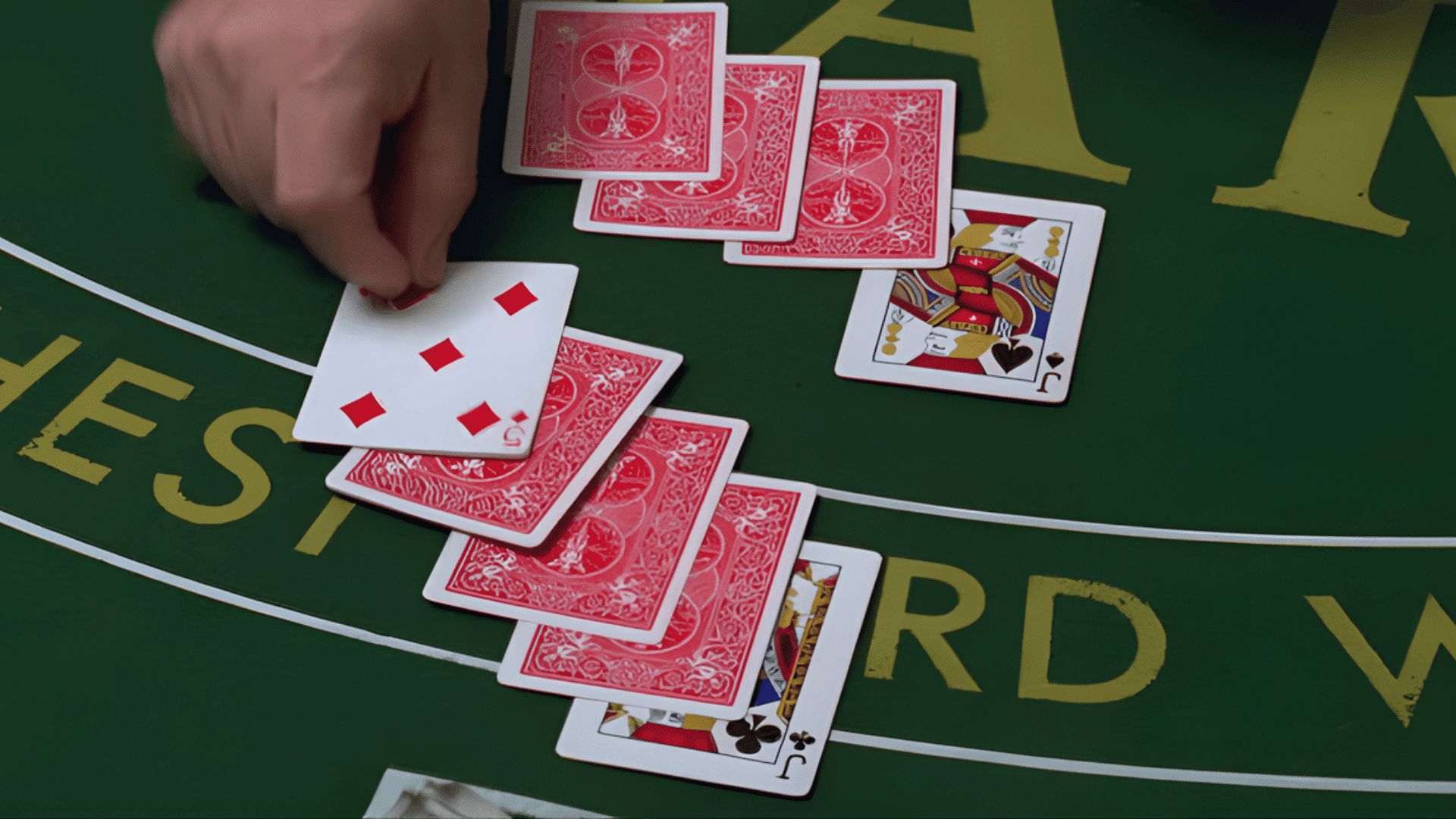
These games center on winning tricks by matching suits or playing higher cards. You need to remember what cards have been played to make good choices.
They give both players a fair shot at winning and work well with a single standard deck of cards.
5. German Whist
German Whist is a two-player trick-taking game with a 52-card deck. Each player gets 13 cards, and the top stock card sets the trump.
In the first 13 tricks, winners take the face-up stock card while losers draw the next. In the final 13 tricks, with no stock left, the player winning more tricks scores the hand. The game combines luck in the draw with strategic play.
How to Play
- Deal 13 cards to each player; turn the top card of the remaining stock face up to set the trump.
- Play 13 tricks for Stage 1: Non-dealer leads any card; follow suit if possible, else any; higher same suit or trump wins – winner takes face-up stock card, loser takes next face-down card.
- Turn the new top stock card face up; the winner leads the next trick—repeat until the stock is empty.
- Play final 13 tricks (Stage 2) with no stock; keep track of won tricks.
- The player with the majority (7+) of Stage 2 tricks wins the hand; alternate deals until one wins a set number of hands.
Game Details
- Decks: 1 standard 52-card deck
- Time: 20-30 minutes per game
6. Cassino
Cassino is a two-player card-capture game using a 52-card deck. Players are dealt four cards each, with four face-up on the table.
On their turn, they play a card to capture or build groups for future captures. Points are scored for most cards, spades, aces, and certain tens and twos, and the first to 21 wins. The game rewards planning and strategy.
How to Play
- Deal four cards each and four face up to the center; repeat until the deck is empty (dealer says “last” on the final deal).
- Take turns playing one hand card to capture a matching rank on the table, sum to your card’s value, or trail without capture.
- Build by adding your card and table cards to make a group announced by capture number (e.g., 5-build).
- Captured cards or builds go to your pile; the last player to capture takes any left on the table.
- Score: 3 for most cards, 1 for most spades/ace, 2 for 10 of diamonds, 1 for 2 of spades; first to 21 wins.
Game Details
- Decks: 1 standard 52-card deck
- Time: 20-40 minutes per game
7. Spades (2-Player Variant)
Spades for Two is a two-player trick-taking game with a 52-card deck. Each builds a 13-card hand from the top of the deck. Spades are trump, and players bid on tricks from 0–13.
Follow suit if possible; the highest card of the led suit or the highest spade wins. Meeting your bid scores points, with bonuses or penalties for nil bids. First to 500 wins, combining bidding and trump strategy.
How to Play
- Shuffle deck; players alternate drawing top card—keep it or discard to pile and draw next—until each has 13 cards (26 set aside).
- Second player bids tricks first (0-13, nil optional); first player bids next.
- Second player leads first trick (no spades until broken); follow suit if possible, else any—highest of lead suit or spade wins.
- Winner leads next; play 13 tricks.
- Score 10 points per bid met +1 per overtrick; -10 per under; 10 overtricks =100 penalty; nil=100/200 bonus/penalty; first to 500 wins.
Game Details
- Decks: 1 standard 52-card deck
- Time: 30-45 minutes per game
Speed and Racing Games
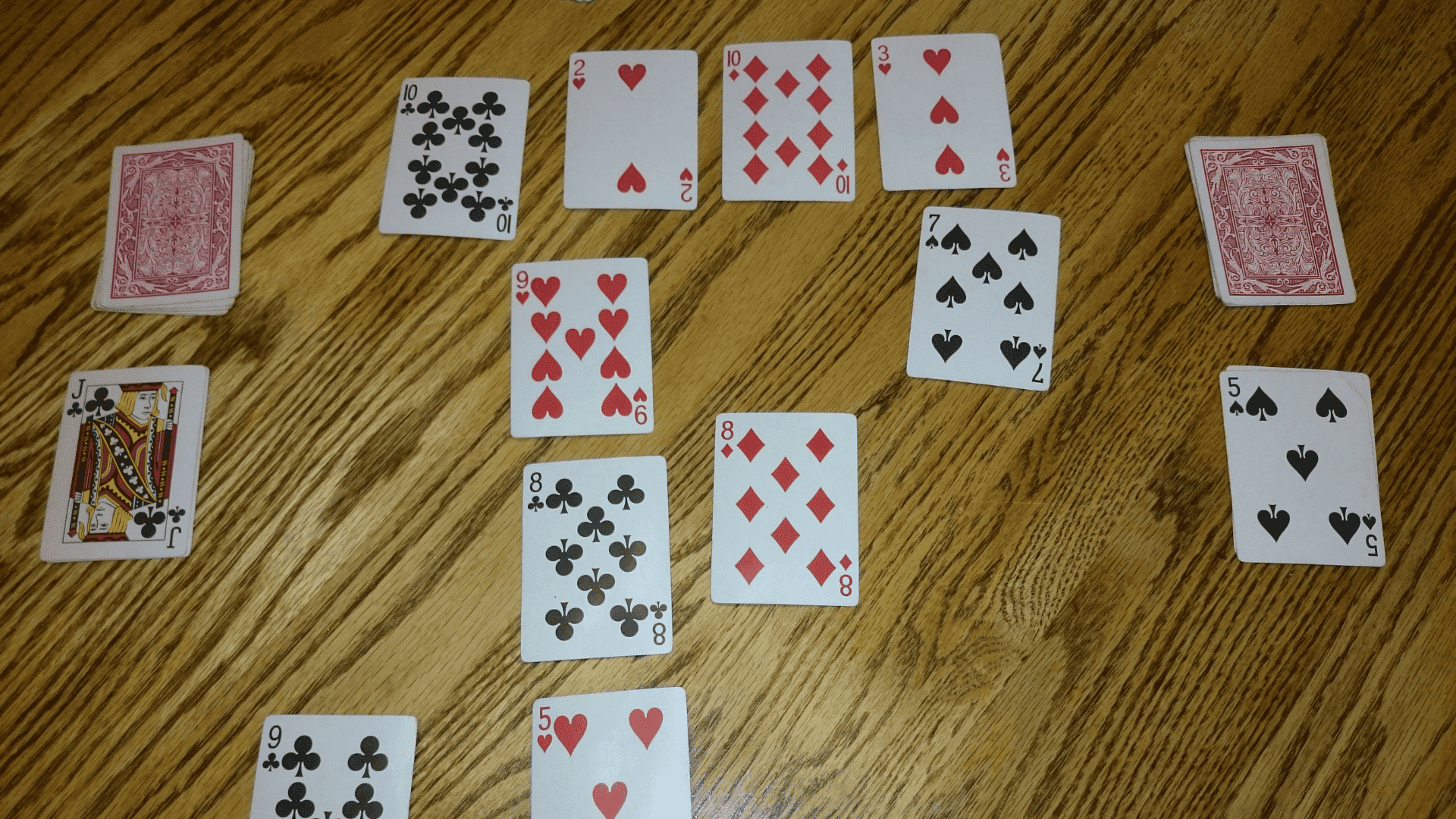
These games let both players play cards at the same time to clear their hands fast. They bring lots of energy and quick fun with no waiting for turns.
They use a single standard deck for two players, creating exciting moments full of Speed and surprises.
8. Speed
Speed is a fast-paced race in which both players try to empty their hands and draw the piles first. You play cards onto two center piles using cards that are one rank higher or lower than the top card shown.
Everyone plays at the same time, so quick thinking and fast hands decide the winner. Many people say it is one of the most exciting games because of the constant action and no turns to wait for.
How to Play
- Deal the deck evenly so each player receives 26 cards. Each player places a stock pile face down and draws 5 cards into their hand.
- Place two cards face up in the center to start the play piles.
- Both players play at the same time, placing cards that are one rank higher or lower than the top card of either center pile.
- Whenever you play a card, draw from your stock pile to return your hand to five cards if possible. If neither player can make a move, flip new cards onto the center piles and continue.
- The first player to play all cards from both their hand and stock pile wins.
Game Details
- Decks: 1 standard 52-card deck
- Time: 5-15 minutes per game
Note: Speed has many house-rule variations, so setups may differ slightly.
9. Spit
Spit is a high-energy game with no turns. Both players race to play cards in sequence onto two shared spit piles in the center. When you get stuck, you slap your next card from your deck to start or restart a spit pile.
The chaos and fast slapping make every round feel wild and fun. Players often enjoy the loud laughs and quick finishes it brings to game nights.
How to Play
- Deal 26 cards each face down as a personal deck. Each lays the top 4 face up in a row.
- Say “Spit!” Both slap the top deck card to the center to start 2 spit piles.
- Play simultaneously from your row to either the spit pile if your card is one rank higher or lower than the top card showing.
- When both are stuck, say “Spit” again; both slap the next deck card to the spit piles.
- First to empty the deck and row wins.
Game Details
- Decks: 1 standard 52-card deck
- Time: 5-10 minutes per game
10. War
War is a luck-based two-player game where players flip cards simultaneously; the higher card wins both.
Ties trigger a “war,” with extra cards at stake. Play continues until one player wins all cards, making for long, unpredictable, and surprisingly tense games.
How to Play
- Deal the entire deck evenly (26 face down each).
- Both flip-top cards at the same time; the higher rank takes both and puts them under its own deck.
- Tie: Say “War!” Each puts 3 face down, then 1 face up on top of the matched cards.
- Higher face-up wins all 10 cards; repeat the war if tied.
- Play until one player has all the cards.
Game Details
- Decks: 1 standard 52-card deck
- Time: 10-40 minutes per game
11. Palace (Shithead)
Palace, also called Shithead, is a shedding game where the goal is to get rid of all your cards before your opponent. You start with cards face down, face up, and in hand, and play equal or higher ranks onto the center pile.
Special cards like twos reset the pile, or tens burn it. When your hand is empty, you move to face-up cards, then face-down ones. The last player left with cards loses, which adds pressure and strategy to the fast play.
How to Play
- Deal 9 cards each: 3 face down in a row, 3 face up on top of them, 3 in hand. Rest as a draw pile.
- Start by playing from hand: 1-3 cards equal or higher rank than the center pile top.
- Draw from the deck to keep 3 in hand; can’t play: pick up the pile to hand.
- Empty hand? Play from face-up cards next.
- Flip face-down cards one by one last. First to empty all wins.
Game Details
- Decks: 1 standard 52-card deck
- Time: 10-20 minutes per game
Slap and Reflex Games
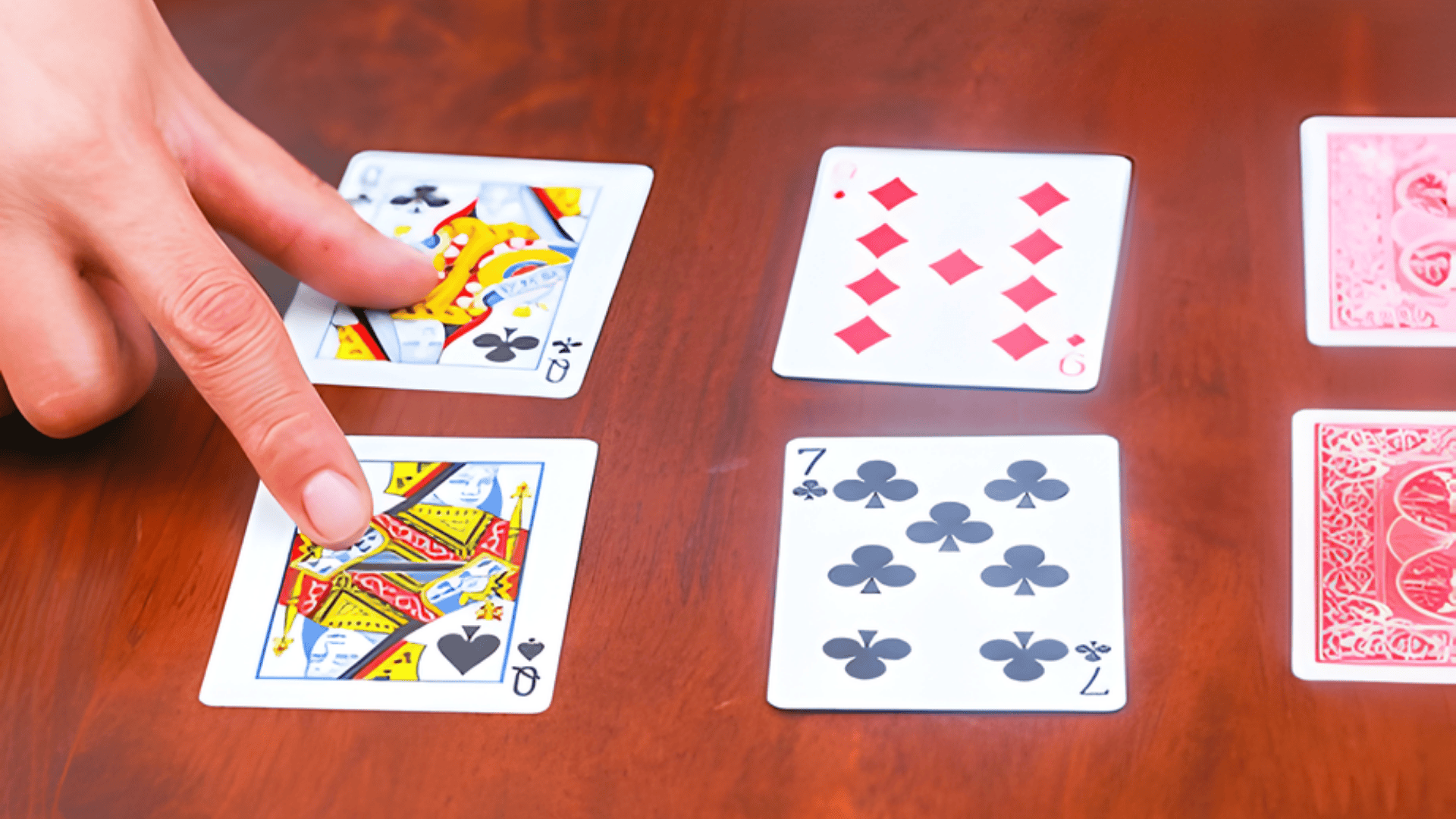
These games use quick slaps on special cards or patterns to claim piles. They create noisy action and test hand speed. Both players use one standard deck for rowdy matches full of shouts and surprises.
12. Slapjack
Slapjack is an easy game in which players flip cards one by one into a center pile. When a Jack shows up, the first person to slap the pile grabs all the cards under it and adds them to their own deck.
Wrong slaps mean you give one card away as a penalty. It gets wild as piles grow, and sharp eyes win the day. Perfect for kids and grown-ups who want fast, loud fun.
How to Play
- Deal all 52 cards face down to each player, then square up your piles.
- Take turns, starting with the player to the left of the dealer: flip your top card face up to the center.
- The first to slap a Jack wins the entire center pile and puts it under their deck.
- If you slap a non-Jack, give one card face down from your pile to the player who flipped it.
- The slapper of a Jack starts the next turn; play until one player has all the cards.
Game Details
- Decks: 1 standard 52-card deck
- Time: 5-15 minutes per game
13. Egyptian Rat Screw
Egyptian Rat Screw mixes slapping combos like doubles or sandwiches with face card challenges. Players flip cards to the center in turns. Slap quickly on matching pairs or patterns to steal the pile.
Face cards give the next player a limited number of tries to beat it, or you win. Penalties add risk to every slap. This chaotic setup makes for non-stop excitement and big laughs.
How to Play
- Deal all cards face down evenly and square up each player’s pile.
- Take turns flipping the top card face up to the center pile.
- Slap first on combos like doubles (same rank next to each other), sandwiches (same rank around one card), or different sets to win the pile.
- On face cards (J=1, Q=2, K=3, A=4), the next player has that many chances to reveal another face card. If not, the face card player wins the pile.
- Wrong slap adds penalty cards to the bottom of the pile; the winner starts next; play until one has all the cards.
Game Details
- Decks: 1 standard 52-card deck
- Time: 10-20 minutes per game
14. James Bond
James Bond is a rapid race to match four cards of the same rank in each of your six piles. Swap one card at a time from your face-down piles with the center row while both play at once.
Quick hands let you grab good matches before your opponent. No turns mean constant motion and close finishes. Shout your win name first to claim victory.
How to Play
- Deal six face-down piles of four cards each to both players; place the last four face-up in a center row.
- Both players swap at the same time: pick one pile, peek, trade one card with one from the center row if helpful.
- Put the pile back face down and grab your next pile fast.
- Always keep four cards face up in the center after each swap.
- First to match four-of-a-kind in all six piles shouts “James Bond!” and wins.
Game Details
- Decks: 1 standard 52-card deck
- Time: 5-10 minutes per game
15. Beggar-My-Neighbour
Beggar-My-Neighbour turns court cards into penalties where the next player must play a set number of plain cards: ace needs four, king three, queen two, jack one.
Play them quickly or slap in some groups to claim. If you hit a court during pay, roles switch. Piles build up huge with swings, making it a test of patience and luck in simple flips.
How to Play
- Deal the deck evenly, face down, to each player (26 cards each).
- Take turns flipping your top card face up to the center pile.
- On a court card (A=4 pays, K=3, Q=2, J=1 plain cards), the opponent pays that many or loses the pile.
- If the payer plays a court, you now pay instead; continue until plain cards are played.
- The winner takes the center pile to the bottom of their deck and plays next; the first out of cards loses.
Game Details
- Decks: 1 standard 52-card deck
- Time: 10-30 minutes per game
Casual and Matching Games
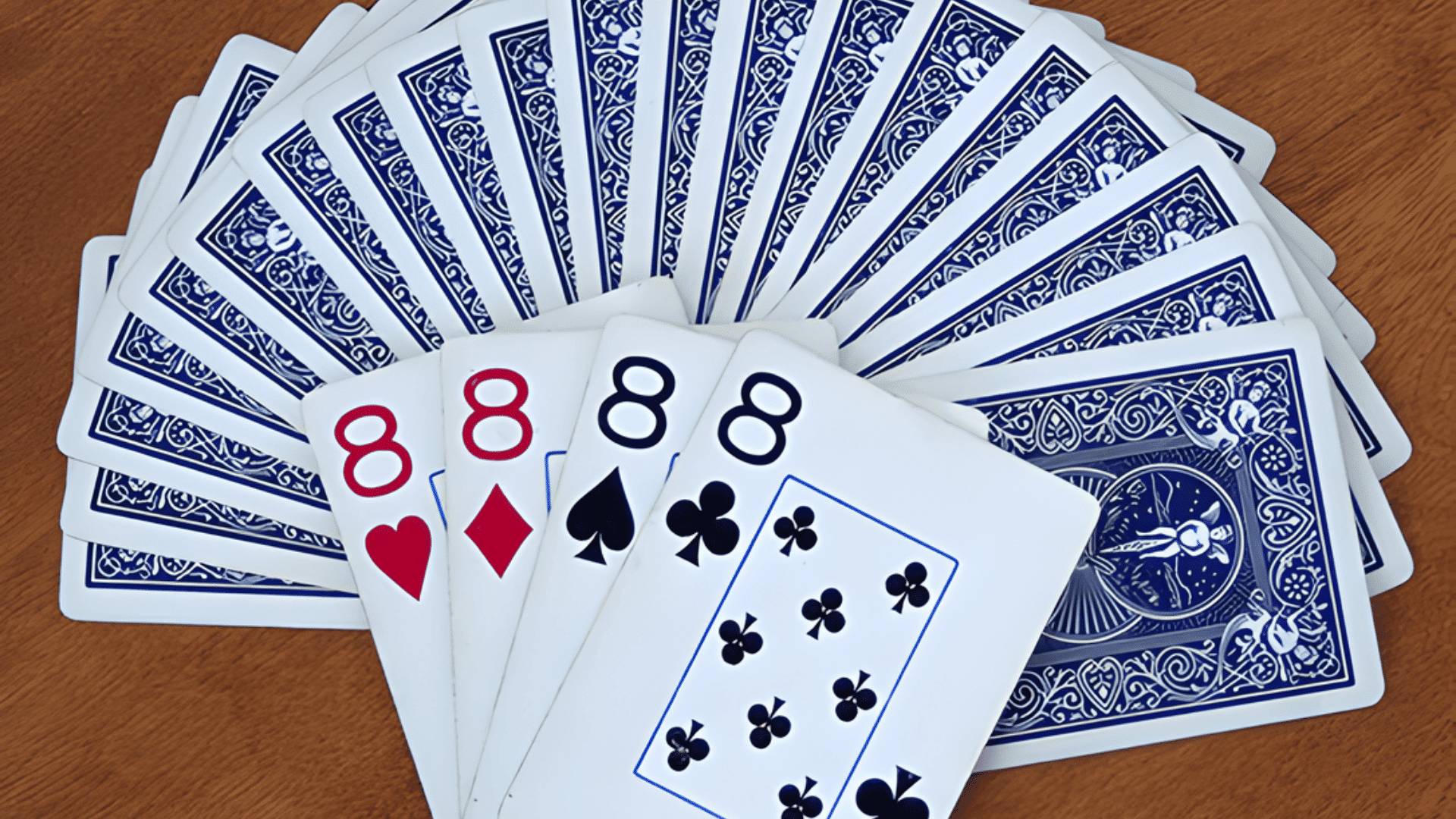
These games have simple rules that let players talk and laugh a lot. They are great for new players because they are easy to learn and full of fun moments. You only need one standard deck to play with a friend or family member.
16. Go Fish
Go Fish is a matching game where you ask your opponent for cards to make pairs of the same rank. If they have it, they give you all of them; if not, you draw from the stockpile.
You keep asking until you can no longer match. Lay down pairs when you have them to score. It feels chatty, like a conversation, and kids love the back-and-forth asking that builds a simple strategy over time.
How to Play
- Deal 7 cards to each player from a standard 52-card deck; place the rest face down as stock.
- Player 1 asks Player 2 for a rank they hold in hand (e.g., “Do you have any threes?”).
- If yes, give all of that rank; ask again. If no, say “Go Fish” and draw the top stock card.
- If the drawn card matches the requested rank, show it and ask again; lay down pairs at any time.
- Play until the stock is gone; the player with the most pairs wins, or the first to empty their hand.
Game Details
- Decks: 1 standard 52-card deck
- Time: 10-20 minutes per game
17. Crazy Eights
Crazy Eights is a shedding game where you match the suit or rank of the top discard card. The eight is wild and lets you pick any suit next.
You draw if you cannot play, and the first to empty their hand wins. It leads to many fun rule changes like UNO, keeping games different each time. Players enjoy the quick plays and surprises from wild cards.
How to Play
- Deal 5 cards each from a standard 52-card deck; place the rest face down as stock, and flip the top card to discard.
- Player 1 plays a card matching suit or rank of discard top; eights wild—name suit after.
- If you cannot play, draw one from the stock until you can; play continues clockwise.
- Keep going until a player empties their hand and wins the round.
- Play multiple rounds; score opponent’s remaining cards (ace=1, face=10, etc.) to 500 points.
Game Details
- Decks: 1 standard 52-card deck
- Time: 15-25 minutes per game
18. Old Maid
Old Maid is a pairing game where you pass cards to make matches and avoid the one unpaired queen, called the Old Maid. Deal almost all the cards evenly, leaving one out.
Take turns drawing from each other’s hands to find pairs. Discard pairs as you go. The player stuck with the Old Maid at the end loses. It brings silly laughs from the chase and bad draws.
How to Play
- Remove one queen from the standard 52-card deck (51 cards left); deal evenly face down.
- Player 1 draws one card at random from Player 2’s hand.
- If it matches a card in your hand, discard the pair face up.
- Player 2 draws from Player 1’s hand; continue passing until all pairs are gone.
- The player left holding the unpaired queen (Old Maid) loses.
Game Details
- Decks: 1 standard 52-card deck (remove 1 card)
- Time: 5-10 minutes per game
19. Switch
Switch is a Crazy Eights game with extra moves, such as changing the play direction or skipping turns.
Match suit or rank on the discard pile, and special cards add twists: seven sends back, ace skips. It keeps the action moving fast with changing rules—players like how fresh it stays, leading to funny skips and reverses during play.
How to Play
- Deal 5 cards each from a standard 52-card deck; stock face down, top card starts discard.
- Match suit or rank on discard; 8 wild (name suit), 7 sends exact rank back, ace skips next, 2 reverse direction.
- Cannot play? Draw one from the stock until able; play continues.
- Special cards change the rules as played.
- First to empty hand wins; play to score points from opponent’s cards.
Game Details
- Decks: 1 standard 52-card deck
- Time: 15-25 minutes per game
Building and Pure Strategy Games
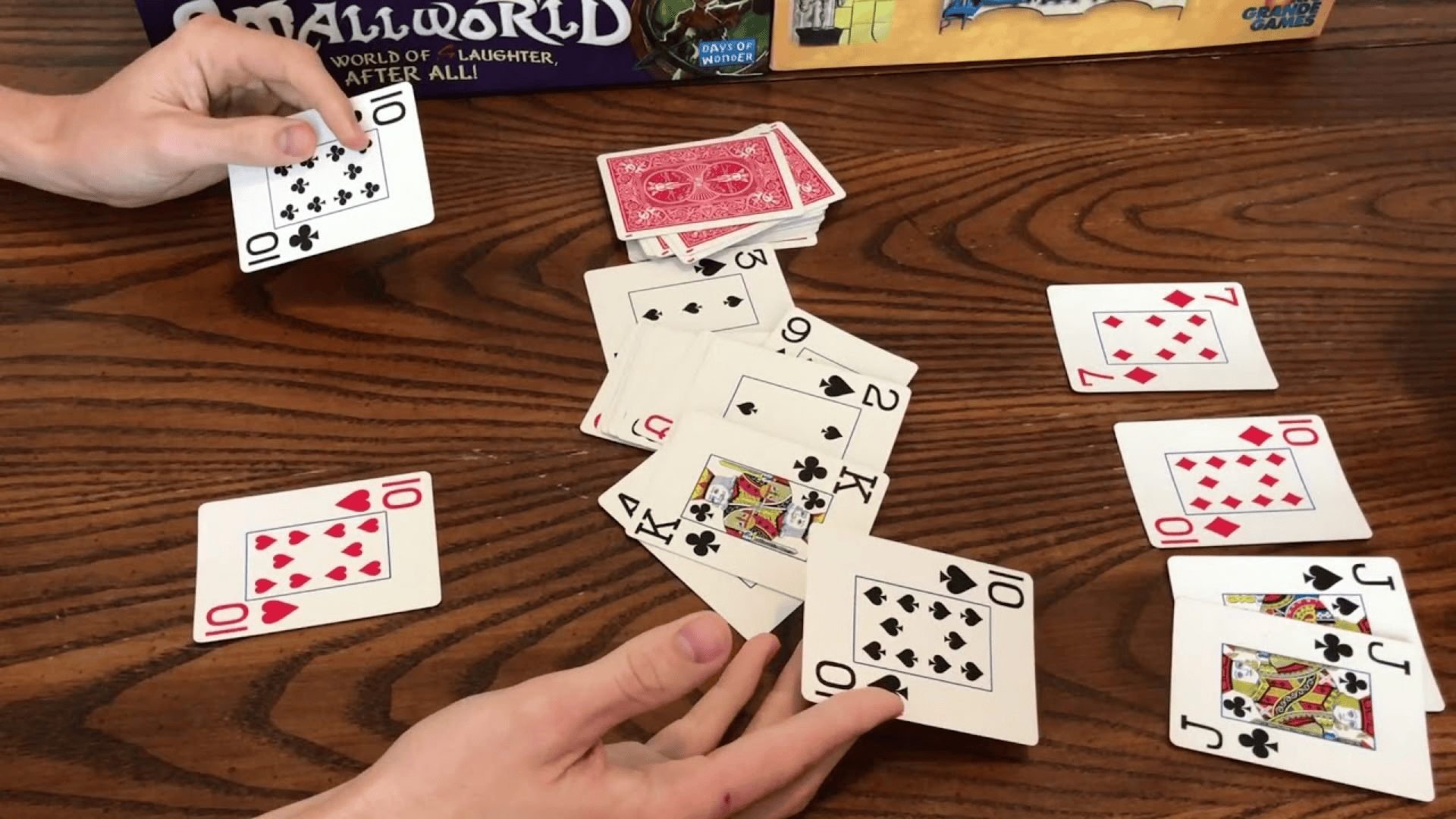
These games focus on laying out cards in patterns or making secret bids to score points. Players must think several steps ahead to beat their opponent. They work with one standard deck and create tense moments in every match.
20. Kings in the Corner
Kings in the Corner is a building race where you play cards from your hand onto foundation piles in the corners and center of the table. Piles must go down in rank with opposite colors, like black on red.
You start new piles with kings in empty corner spots. Play as many cards as you can each turn, then draw one more. The first player to get rid of all cards wins the round and scores points based on the opponent’s hand.
How to Play
- Deal 7 cards to each player; place the remaining cards face down as stock, and turn the top card face up beside it.
- Starting player plays one or more cards from hand: one lower rank and opposite color on any foundation top, or a king to an empty corner (up to 4 corners and center piles).
- Continue playing from hand as long as possible in one turn.
- Draw 1 card from the stock to the hand at the end of the turn.
- First to empty hand wins round (10 points + value of opponent’s cards); play to 50 points.
Game Details
- Decks: 1 standard 52-card deck
- Time: 20-30 minutes per game
21. Trash (Garbage)
Trash, also called Garbage, is a matching game where players race to fill their grid with the correct cards in the right positions. Each player starts with 10 cards face down in a 2×5 grid (top row: A-5, bottom row: 6-10).
You draw cards to match each position’s required rank. The first player to correctly fill all 10 positions wins.
How to Play
- Deal 10 cards face down to each player in a 2×5 grid. Players may not look at them.
- Place the remaining cards face down as the stockpile.
- On your turn, draw the top card from the stock.
- If it matches a face-down position’s rank, place it there face up. Reveal the card underneath.
- If that revealed card fits another empty position, continue placing. Repeat until you reveal a card that cannot be played.
- Your turn ends when you draw or reveal a card that cannot be placed. The first to fill all 10 positions wins.
Game Details
- Decks: 1 standard 52-card deck
- Time: 15-25 minutes per game
22. Cribbage
Cribbage mixes card play and scoring combos like pairs, runs, and sums to 15. During play, add card values up to 31 and peg points right away.
After, score your hand and the shared crib for more points. Use a pegboard or paper to track up to 121. It takes practice to spot the best discards and plays each time.
How to Play
- Deal 6 cards each; each discards 2 face down to the crib (dealer gets the crib). Non-dealer cuts stock for starter card (face up).
- Non-dealer leads first card (value announced); opponent plays card under 31 total, announces running count.
- Peg points during play: 2 for 15/31, 1 pair/last, 2 runs of 3, etc. Restart the count at 0 if neither can play.
- Score 4-card hands (15s=2, pairs=2, runs, flushes=4/5) using starter; dealer scores crib last.
- Alternate dealer; first to 121 peg holes wins.
Game Details
- Decks: 1 standard 52-card deck
- Time: 30-45 minutes per game
23. GOPS
GOPS stands for Game of Pure Strategy, a bidding game with no luck after setup. Remove one suit from the deck. Give each player one full suit as their bidding hand, ranked ace-low to king-high.
Shuffle the third suit face down as prizes. For each prize, bid secretly, and the higher card wins its point value. Ties give zero. The highest total after 13 rounds wins.
How to Play
- Remove one suit (e.g., hearts); player 1 gets spades, player 2 gets clubs (ace low-K high); shuffle the diamonds face down as the prize stack.
- Flip the top prize face up; its rank = points (ace=1 to king=13).
- Each chooses one card from the bidding hand and places it face down.
- Reveal bids; higher rank wins prize points (ties=0). Set used bids aside.
- Repeat for all 13 prizes; the highest score wins.
Game Details
- Decks: 1 standard 52-card deck
- Time: 15-25 minutes per game
24. Cuttle
Cuttle is one of the oldest strategy card games played with a standard deck.
Players score points by playing cards to the table while using special card abilities to remove threats, steal advantages, and disrupt their opponent’s plans.
The goal is to build enough points on your side of the table to reach 21 before your opponent.
How to Play
- Deal 5 cards to each player and place the remaining cards face down as a draw pile. On your turn, draw a card and then make a play, such as scoring points, using a card effect, or affecting cards already in play.
- Play a number card as a point card to add its value to your score. Use certain cards for one-time effects, such as destroying, stealing, or removing cards from play.
- Face cards provide special effects. Most are one-time abilities (Aces, Jacks, Queens) that discard after use, while Kings remain on the table as a permanent disruption to your opponent.
- Continue building points while preventing your opponent from reaching their target score.
- The first player to have 21 or more points in play wins the game.
Game Details
- Decks: 1 standard 52-card deck (no jokers)
- Time: 20-45 minutes per game
25. Bluff (BS)
Bluff, also known as BS or Bullshit, is a lying game where you discard cards face down while claiming ranks in order. Start with aces, then twos up to kings, repeat.
Anyone can call “Bluff!” or “BS!” at any time. If the call is wrong, the caller takes the pile. If right, the discarder takes it. First to empty their hands wins amid lots of laughs and guesses.
How to Play
- Deal all 52 cards evenly face down (extras to the last player).
- Player 1 starts: announces the number and rank (e.g., “two aces”) and places 1+ cards face down in the pile.
- Next player continues sequence (e.g., “one two” or more); can lie about cards played.
- At any time, call “BS!”; flip the pile from top – if lie, the caller takes the whole pile under their deck; if truth, the player takes the pile.
- The caller starts the next play; the first to empty their hand wins.
Game Details
- Decks: 1 standard 52-card deck
- Time: 15-30 minutes per game
The Bottom Line
The best two-player card games prove that simple entertainment often beats complex alternatives. With just a standard deck, you gain access to countless options that range from pure luck to serious strategy.
These games build connections, create memorable moments, and never lose their appeal, no matter how many times you play.
Pick your favorite from the list above, shuffle the deck, and challenge someone to a match today. Have a go-to card game that always delivers fun?
Drop your favorite in the comments below and tell me why it deserves a spot on every game night!
Frequently Asked Questions
What Two-Player Card Games Are Best For Travel?
Speed, Gin Rummy, and Cribbage (keeping score on paper rather than on a board) are highly portable options that require minimal space.
What Two-Player Card Games Work Well for Kids?
War, Go Fish, and Slapjack are perennial favorites for younger players because they rely mainly on luck and simple matching, keeping the focus on fun rather than complex rules.
Do You Need a Special Deck for Two-Player Card Games?
No, the vast majority of the best two-player card games use a standard 52-card deck, making them incredibly accessible and portable.